
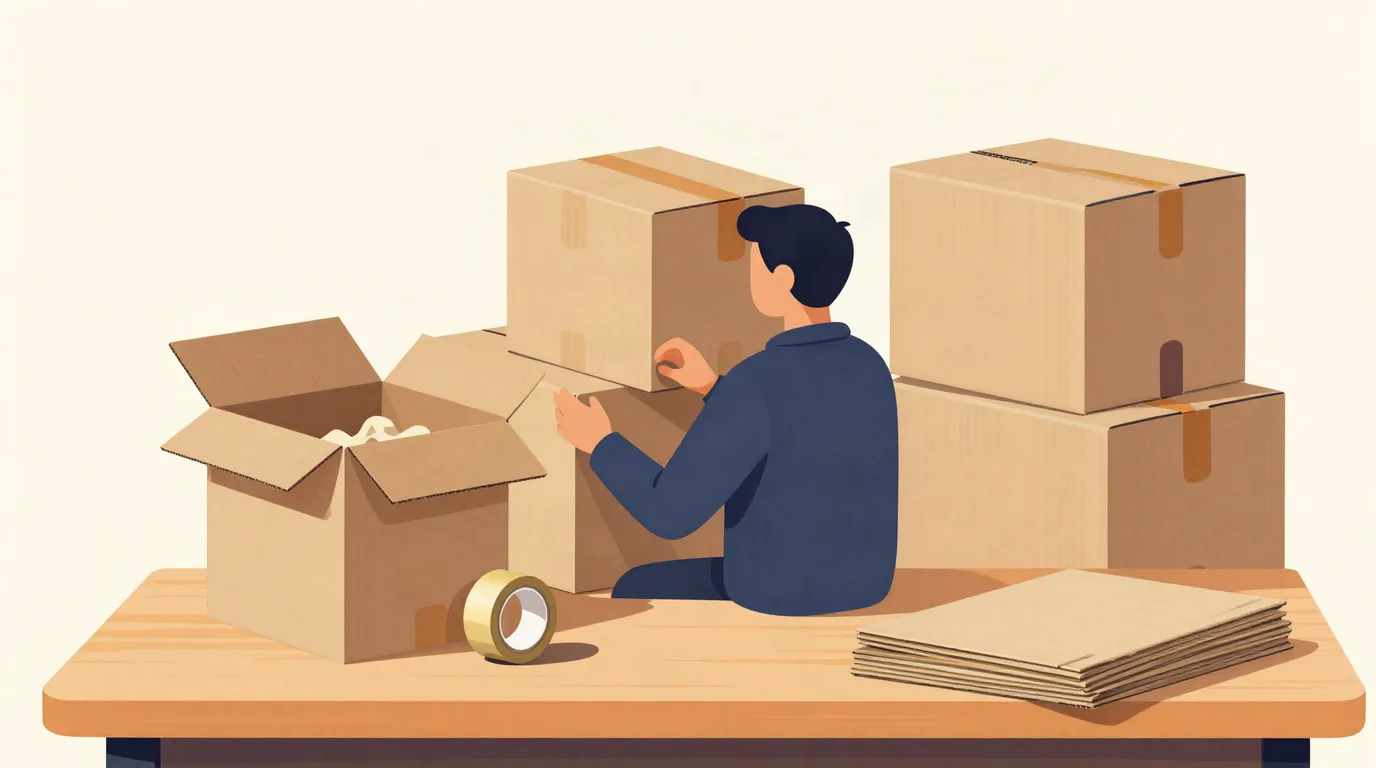
To ship, use a new or sound corrugated box just big enough for the product plus about 5 cm (2 in) of cushioning on every side. Single-wall suits most light parcels; double-wall better protects heavy or fragile items. Check the strength rating printed on the bottom flap, then compare prices using the packed dimensions: an oversized box raises the billable weight.
What is a corrugated box?
Corrugated board is a wavy sheet, the flute, glued between two flat liners. Those waves act like small springs: they absorb shocks and make the box rigid without making it heavy. That is why almost every parcel travels in this kind of box, and not in flat paperboard like a cereal box.
For a merchant, the right box does two jobs at once: the product arrives intact, and you do not pay to ship air.
Single-wall, double-wall or triple-wall
| Type | Construction | Typical use |
|---|---|---|
| Single-wall | One flute between two liners | Clothing, books, cosmetics, most light parcels |
| Double-wall | Two flutes, three liners | Heavy, fragile or high-value items, long-distance shipments |
| Triple-wall | Three flutes | Very heavy or industrial parts, often palletized |
Flute height matters too. A fine flute gives a smooth surface and a thin wall, good for small e-commerce boxes. A taller flute gives more cushioning. For most small businesses a standard single-wall box is enough; double-wall earns its place when the parcel is heavy, fragile or stacked often.
Reading a box’s strength rating
Many boxes carry a small printed seal on a bottom flap, called the box maker’s certificate. It states the board’s strength using one of two measures:
- ECT (Edge Crush Test): resistance to crushing on the edge. The most useful measure for parcels stacked in a truck or a warehouse.
- Mullen (burst test): resistance to puncture. More relevant for items with hard corners that could push through the wall.
- Weight limit: the seal often states the maximum weight the box is designed to hold. Stay under it.
Every carrier publishes its own packaging guidelines, and a box that is too weak can complicate a damage claim. Requirements vary by carrier and service: read the carrier’s packaging guide before shipping anything heavy or fragile, and confirm weight and size limits at the quote step.
Choosing the right size
- Allow about 5 cm (2 in) of cushioning around a fragile item, and not much more: every extra centimetre is multiplied by the other two dimensions in the dimensional weight.
- Measure the outside of the closed box, not the inside: that is the measurement the carrier uses.
- Keep a small range of standard sizes that covers most of your products, rather than a different box for every order.
- For soft goods such as clothing, a padded mailer or poly bag can replace a box and shrink the billed size.
To see how a box size affects billable weight, our free dimensional weight calculator (/tools/dimensional-weight) takes centimetres or inches.
Reusing a box: yes, with care
Reusing a box saves money and waste, as long as it is still sound. Set aside any box that is crushed, damp, torn or soft at the corners: it has lost much of its strength.
- Remove or fully cover old labels and barcodes, so a scanner cannot read the wrong address.
- Seal with wide packing tape in an H pattern on the top and bottom. Avoid string and ordinary paper tape.
- Place the new label flat on the largest face, away from the seams.
Compare the price with your real dimensions
MesColis is not a carrier. When you create a shipment, you enter the weight and dimensions of the packed box, and we show the carriers and services that serve your lane side by side, each with its total price for that parcel. So you see right away whether a smaller box changes the price, and your saved box sizes are one click away on the package step.
With a free MesColis account, no contract and no minimum volume, you compare the carriers that serve your lane before you buy the label.