
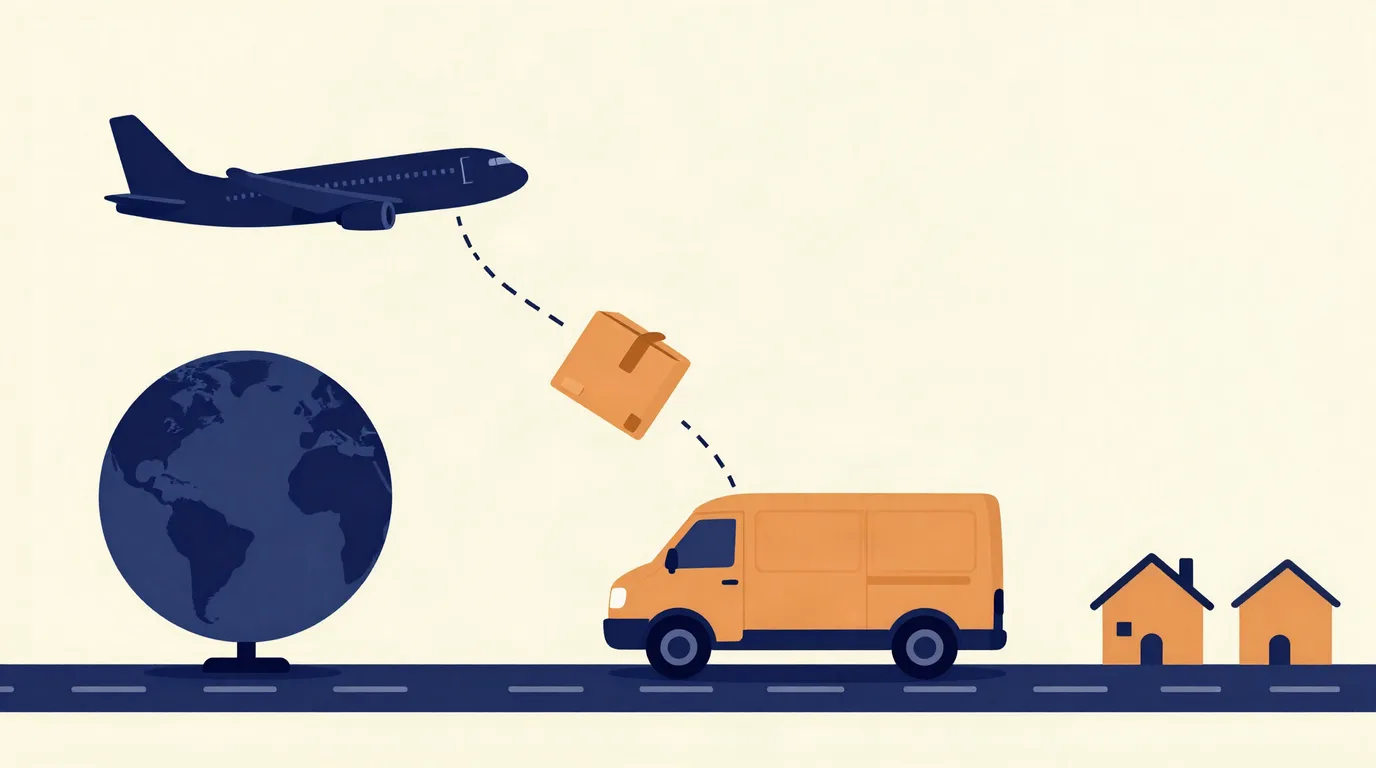
An international courier (UPS, DHL Express) usually keeps your parcel inside its own network all the way to the door and clears customs itself. A postal service (Canada Post) carries the parcel to the destination country, then hands it to the local post office for final delivery. Couriers are built for speed and detailed tracking; the post is often the economical route for small parcels and can deliver to PO boxes. Compare both for your parcel before you buy.
Courier or post: the real difference
The difference is who handles the parcel once it crosses the border. A courier runs its own network of aircraft, sorting hubs and drivers in most of the countries it serves. The same carrier picks the parcel up from you and hands it to the recipient.
An international postal shipment is a relay: Canada Post moves the parcel to the destination country, where the national postal operator (La Poste in France or Royal Mail in the UK, for example) takes over for final delivery. That worldwide postal network is what lets the post reach almost any address, PO boxes included.
Side-by-side comparison
| Factor | Courier (e.g. UPS, DHL Express) | Post (e.g. Canada Post) |
|---|---|---|
| Who delivers at destination | The same carrier, end to end in most countries | The destination country’s post, after the handoff |
| Tracking | Usually detailed at every step of the network | Depends on the service: some are tracked, some are not; detail can vary after the handoff |
| Customs clearance | Handled by the carrier or its broker | Done on arrival by the local post or customs |
| Charges to the recipient | Duties, taxes and sometimes brokerage fees, unless prepaid | Duties, taxes and sometimes a local post handling fee |
| PO box | Usually needs a street address | Possible, the post runs PO boxes |
| Typical fit | Urgent, high-value or commercial shipments | Small, light parcels and less urgent shipments |
Every service has its own coverage, timing, tracking and clearance rules, and they change by country. This table describes general patterns, not a guarantee: check the estimated delivery date and the service terms at the quote step.
When to choose a courier
- Timing matters: a customer waiting on a part, a sample for a buyer, an order promised by a date. Express services show an estimated delivery date you can compare.
- The value is high: one network, detailed tracking and proof of delivery make it easier to follow up if something goes wrong.
- The shipment is commercial: the carrier clears customs itself and may offer prepaid duties (DDP), which spares the recipient a surprise bill.
- You want one point of contact: a single carrier from pickup to delivery.
When to choose the post
- The parcel is small and light: that is often where the post is most competitive. Compare anyway: it is not automatic.
- The recipient has a PO box or lives in an area couriers serve less well.
- Timing is flexible: a customer willing to wait a little longer to pay less.
- You ship low-value items where full step-by-step tracking is not essential.
For a detailed head-to-head between the two approaches, see our Canada Post vs DHL Express comparison, and for two couriers against each other, DHL Express vs UPS.
Duties and taxes: who pays, and when
Both routes declare the contents to customs in the destination country, and duties or taxes can apply either way. What changes is who bills them and when. With a courier, the carrier or its broker often advances them and bills the recipient, sometimes with a brokerage fee. With the post, they are usually collected on delivery by the local post office, sometimes with a handling fee.
To avoid a customer refusing a parcel over a bill at the door, look at prepaid duties (DDP). On MesColis, every international shipment goes either DDU (the recipient pays) or DDP (you prepay). With DDP, the price shown includes shipping, duties, taxes and estimated fees. Some services only accept DDU: that is flagged on the duties step.
Compare both for your parcel
MesColis is not a carrier. Enter the destination, weight and dimensions of your parcel, and we show the courier and postal services that serve that lane side by side, each with its total price and estimated date. Then pick based on what matters for that shipment: price, date or tracking.
With a free MesColis account, no contract and no minimum volume, you compare courier and postal options for the same parcel before you buy the label.